We asked ChatGPT 40 times who we should use. This is what it looked at
28 October 2026
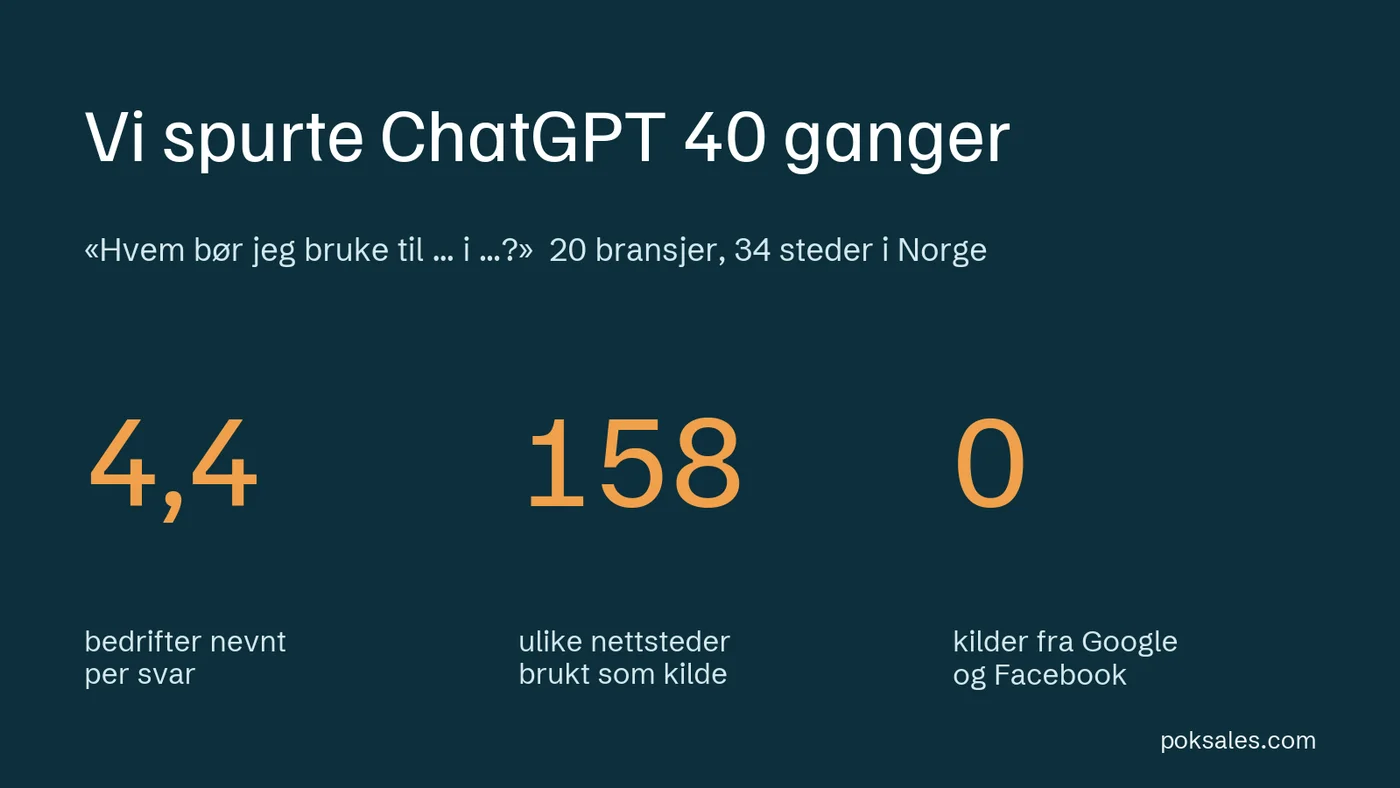
On 28 October 2026 we asked ChatGPT, in Norwegian, the same question a customer would type, “Hvem bør jeg bruke til rørlegger i Drammen?” (“Who should I use for a plumber in Drammen?”), and ran it 40 times across 20 industries in 34 cities and towns, from Oslo and Bergen to Florø and Mo i Rana. We used the same model and web search that sit behind our AI test, saved every answer and every source, and counted afterwards.
We are keeping the names of the recommended businesses to ourselves, since they are beside the point here. What is interesting is where ChatGPT gets its answer, because that is where you can do something about it.
How many businesses does ChatGPT recommend?
On average four to five per question, and the most was seven. In a city with thirty plumbers, that means the customer hears about four or five of them, and the rest do not exist in that answer, however good they are.
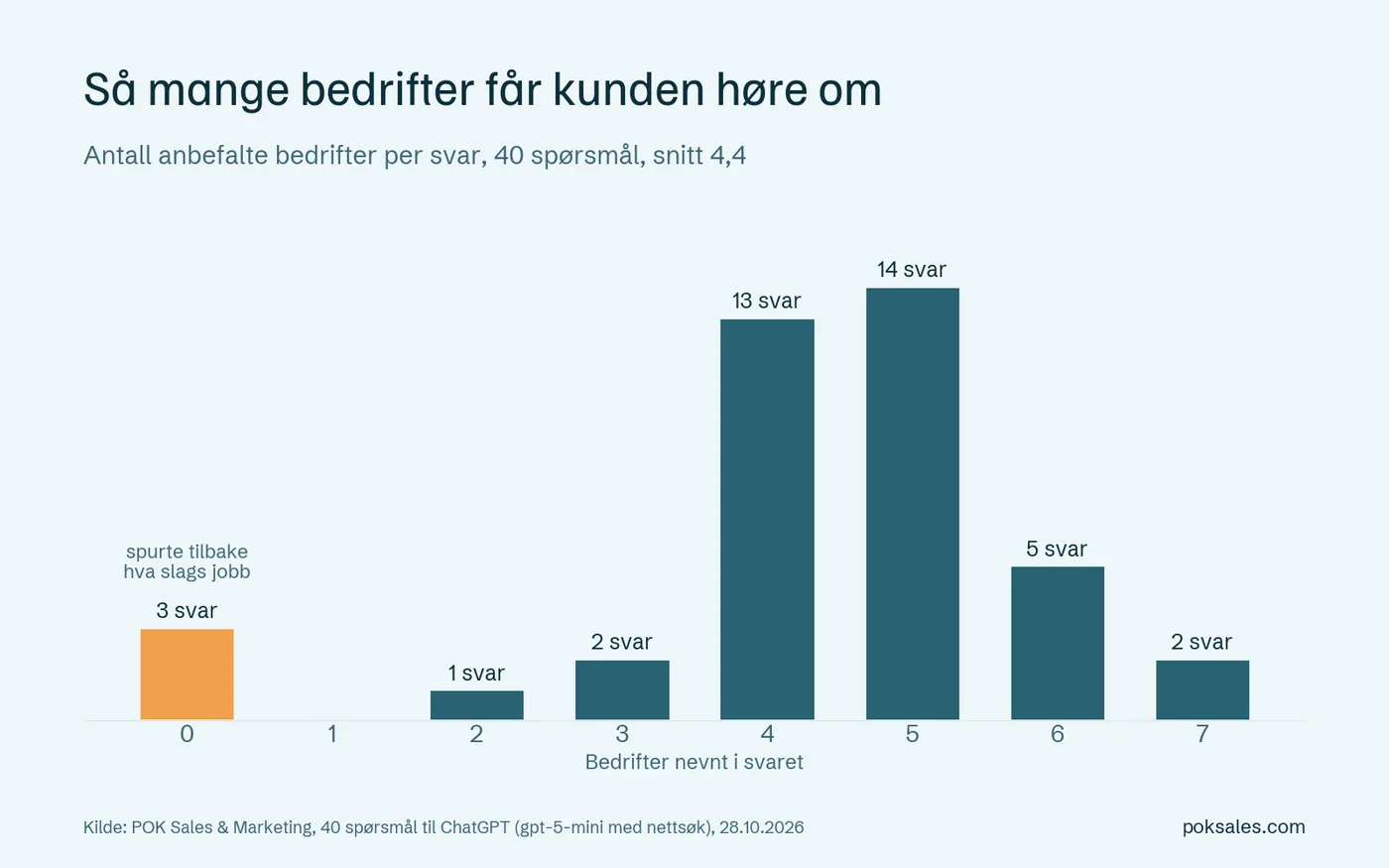
There was almost no difference between large and small places. The cities averaged 4.5 names and the smaller towns 4.2, so being based somewhere with few competitors does not let you off the hook.
In three of the 40 answers we got no names at all. Those were carpenter in Oslo, lawyer in Bergen and skin care in Elverum, and ChatGPT replied with a question back: what kind of job, what kind of case, what kind of treatment. That is worth noting, because a customer who answers “kitchen” or “employment law” then gets the names of the businesses that state clearly that they do exactly that.
Which sources does ChatGPT use?
The 40 answers cited 230 sources spread across 158 different websites, which is about six per answer. The ones that came up most often were Mittanbud (a Norwegian marketplace where customers collect quotes), Forbrukerrådet (the Norwegian Consumer Council), Sjekkscore and Direktoratet for byggkvalitet (the Norwegian Building Quality Agency, which keeps the register for Sentral godkjenning, the central approval scheme for tradespeople), followed by Gule Sider (the Norwegian Yellow Pages) and Proff (a business directory).
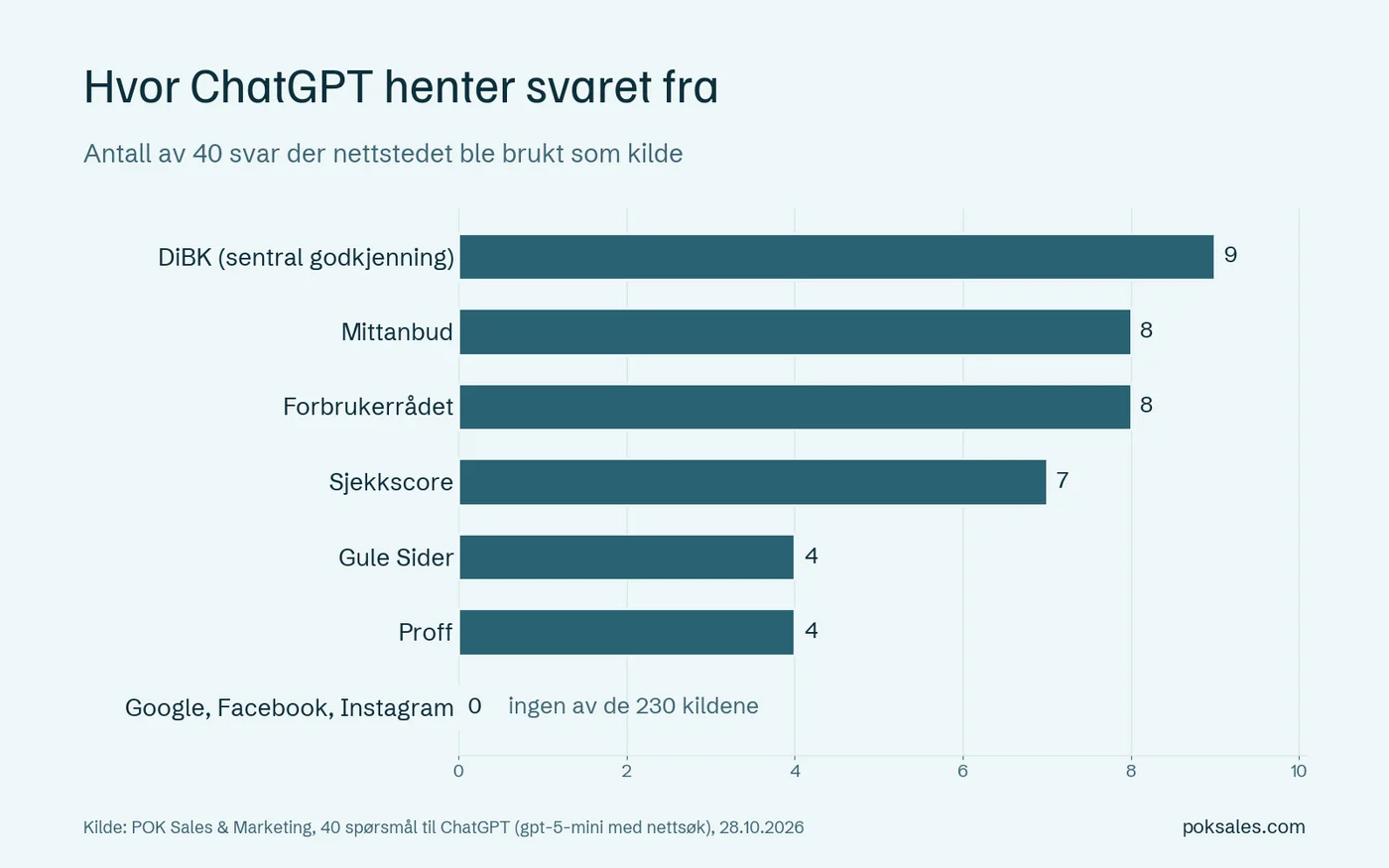
Google profiles, Google Maps, Facebook and Instagram did not appear in a single source. Google was mentioned in the text of 11 of the answers, most often as advice that the customer can check reviews there, but ChatGPT did not get its information from it.
That does not mean the Google profile is unimportant, since it is still what the customer sees when they search on Google. But when the customer asks ChatGPT, other places count, and a business that only exists on Facebook and in Google Maps is almost invisible there.
Does it matter whether you have your own website?
Yes, and it was the clearest finding. Around four in ten of the recommended businesses had their own website among the sources, and it was the page ChatGPT read to find out what they do, where they are based and why they were worth mentioning.
For the rest, ChatGPT had to build the recommendation on what others wrote about them, in directories, quote services and registers. It is possible to get included that way, but then the directory decides what is said about you, and often there is very little.
Only 6 of the 40 answers mentioned the word website or homepage, so the customer rarely learns that ChatGPT has read your site, yet that is where much of the answer comes from.
One of the sites used as a source was built with an AI tool and was still on a free test address. It was included anyway, because it said clearly what the business did and where, so the content is what ChatGPT reads, and it hardly looks at the design.
What does ChatGPT look for when it chooses?
We also looked at the advice ChatGPT gave the customer on how to choose, and it was strikingly similar across industries:
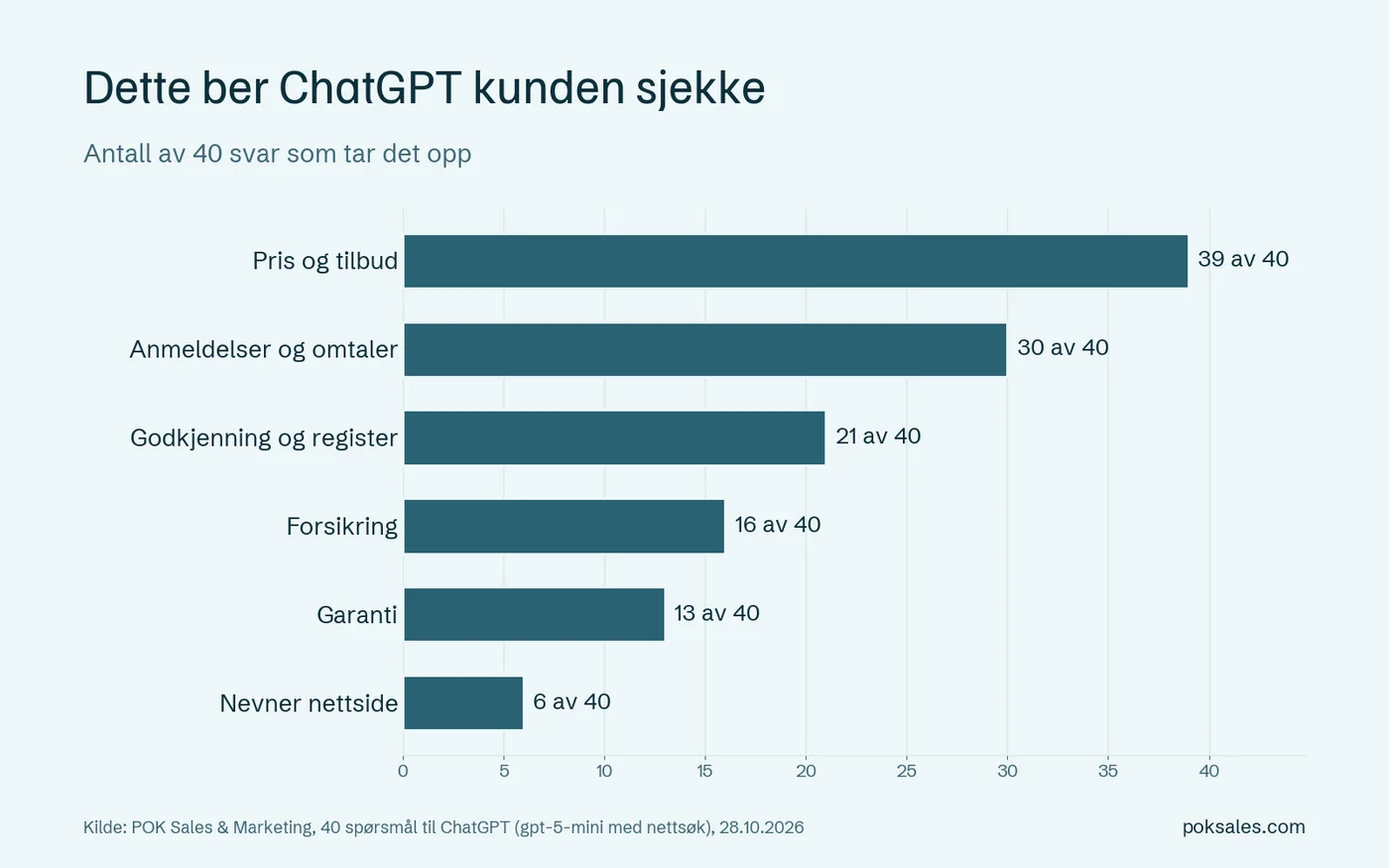
- 39 of the 40 answers were about price and quotes: ask for a written price, compare two or three.
- 30 of the 40 mentioned reviews or testimonials.
- 21 of the 40 mentioned approval, authorisation or registration, such as Sentral godkjenning for tradespeople and Elvirksomhetsregisteret (the register of electrical businesses) for electricians.
- 16 mentioned insurance and 13 mentioned warranty, and references from similar jobs came up again and again.
These are the same things the customer is told to check, so a business that has its price level, approvals, insurance and examples of jobs on its own site answers the questions before they are asked. ChatGPT tends to highlight that business, since it has something concrete to point to.
What should a small business do?
Based on what we saw, four things recur among the businesses that were included:
- A website of your own that says the simple things clearly: what you do, where you work, and one page per service. “Bathrooms in Drammen and Lier” gives ChatGPT much more to work with than “plumbing services”.
- Approvals and registrations where they belong, and linked from your own site. Sentral godkjenning, Elvirksomhetsregisteret, trade associations, whatever ChatGPT actually checks.
- Correct and consistent information in the directories it uses, Gule Sider, Proff and Mittanbud, with the same name, address and phone number as on your website.
- Price, warranty and examples visible. A price level or a fixed price on the most common jobs gives both the customer and ChatGPT something to hold on to.
How reliable are the numbers?
This is a snapshot from one day. We used the same model and web search that ChatGPT uses, but through OpenAI's API instead of the app, and the answers vary a little from one time to the next and from person to person. 40 questions are enough to see a pattern but too few to give exact percentages, and we counted own websites by comparing business names with the web addresses in the sources, so “four in ten” is a round figure.
The pattern was still clear enough that we are willing to say it straight out: the businesses ChatGPT recommends are mostly the ones it finds something concrete to read about, on their own site or in the directories it trusts.
If you want to see what ChatGPT says in your industry and your city, and whether you are included, you can take the AI test for free. It takes half a minute. If you are wondering about the difference between regular SEO and visibility in AI search, we have written about it in SEO is no longer enough: GEO and AEO explained.